
Why the Right Size Dog Bed is So Important
A dog bed should adapt to your dog's body, not the other way around. If the size isn't right, it can not only impair comfort but also negatively affect their health in the long run. It is especially important that your dog can stretch out completely without their head or hindquarters hanging over the edge. This is the only way for the spine to remain in its natural position and for the joints to be evenly relieved.
To find out why this relief is particularly crucial for puppy development and senior health, read our guide to dog sleep in different life stages.
A bed that is too small often forces dogs into unnatural sleeping positions – which can lead to tension, restless sleep, or even early joint problems. Furthermore, the pressure-relieving effect of the foam can only fully unfold if the dog lies relaxed. If the surface is too small, localized pressure can occur, which impairs circulation and can lead to incorrect loading.
However, the bed can certainly be too large. It offers your dog more freedom of movement and reliably supports the body regardless of the sleeping position.

How Weight & Foam Interact
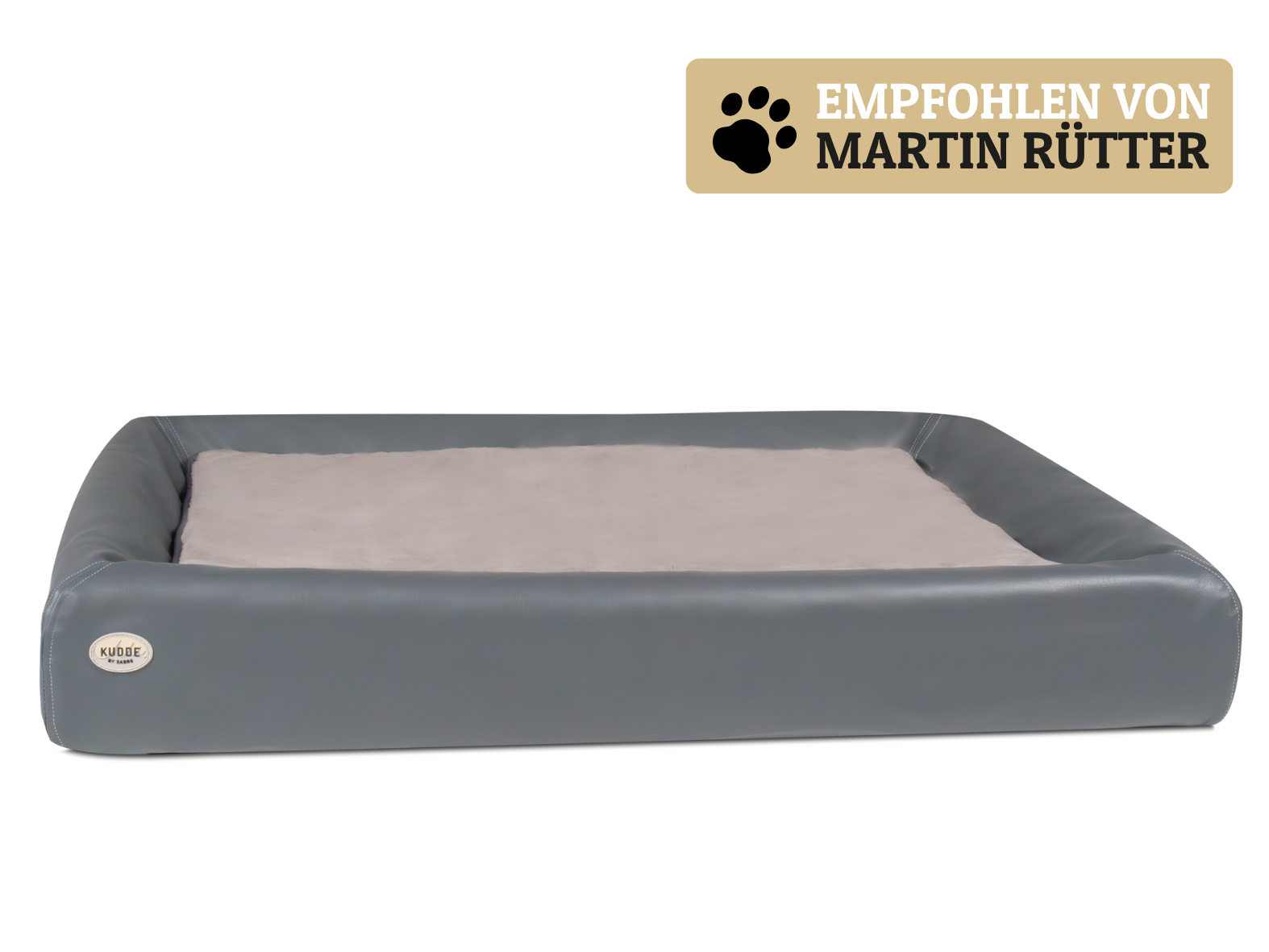
When choosing the right KUDDE dog bed, your dog's weight also plays an important role – because it significantly influences how the foam core can exert its supportive and pressure-relieving effect. Our KUDDE dog beds are designed for a specific maximum weight. If this is exceeded, the core loses stability, which can impair lying comfort and ergonomic support in the long term.
There is no minimum weight, however. This is because the high-quality cold foam in the standard core is point-elastic – meaning it yields exactly where the dog's body rests, without the entire bed sinking. Even lighter dogs exert enough pressure to trigger this targeted adaptation. This way, even very small or delicate dogs benefit from an optimally supportive and pleasantly stable lying surface, without sinking too deeply or lying on a "hard slab."
For special needs:
For dogs with special needs or a higher demand for comfort, there is the Special variant: It combines the proven cold foam edge with a lying surface made of viscoelastic memory foam. This reacts to body heat and pressure, adapts even more precisely to the body shape, and offers targeted gentle relief for joints and muscles. The memory foam is therefore ideal for arthritic conditions, chronic pain, or for dogs who prefer to lie softer without being unstable. For dogs with special needs or a higher demand for comfort, we therefore always recommend an orthopedic sleeping place.
You can see how memory foam compares to cold foam and conventional beds in our dog bed pressure test with thermal imaging.
Misconception: Firm core = uncomfortable core
A widespread misconception is that a firm core is automatically uncomfortable. But with high-quality foams like KUDDE, firmness does not mean hardness. On the contrary: The stability ensures that your dog lies ergonomically correctly and can get up more easily – especially helpful for older or mobility-impaired dogs who might otherwise have difficulty sinking into soft surfaces.
How to Find the Right Size for Your Dog
The right size is crucial for your dog's comfort and health – and it can be found quickly with a few simple steps:
- Measure length: Have your dog stand straight and measure the length from the tip of their nose to the base of their tail. This measurement will serve as a guide for selection.
- Consider weight: Also pay attention to your dog's weight. Each KUDDE is designed for a specific maximum weight – there is no minimum weight.
-
Find the size: Compare your measured length and weight with the information in the size chart. Make sure your dog fits well within the inner dimensions – ideally, your measurement should be slightly smaller than the inner dimensions, never larger.

KUDDE Dog Bed Size Chart
Below we have listed the size chart for our KUDDE dog beds. An overview of all KUDDE sizes, including inner and outer dimensions, can also be found directly with the product. This way, you can compare your measurements directly while shopping with the available variants and find the right size for your dog.

How to Tell if Your Dog's Bed is Too Small
These signs may indicate that you should choose a larger size:
- Your dog consistently curls up tightly.
- They regularly leave the bed to stretch out next to it or on the floor.
- Your dog avoids the bed entirely or uses it reluctantly.
- They show restless behavior, frequent turning, or changing of their sleeping position.
Tip: Observe your dog's sleeping behavior over several days – it provides valuable clues to the appropriate bed size.
Conclusion: Comfort Begins with the Right Size
A dog bed that is too small can lead to physical discomfort in the long run – one that is too large, however, rarely becomes a problem. When choosing, pay particular attention to your dog's length and weight. With the KUDDE dog bed, you'll find a well-designed solution that combines comfort, stability, and adaptability – for a restful sleep that truly benefits your dog.